Đề cương ôn tập Học kì 1 Tiếng Anh 8 năm 2025–2026 trường THCS Lê Quý Đôn (Hòa Bình)
Xem trước nội dung
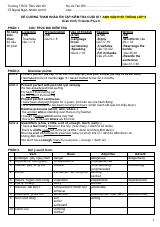
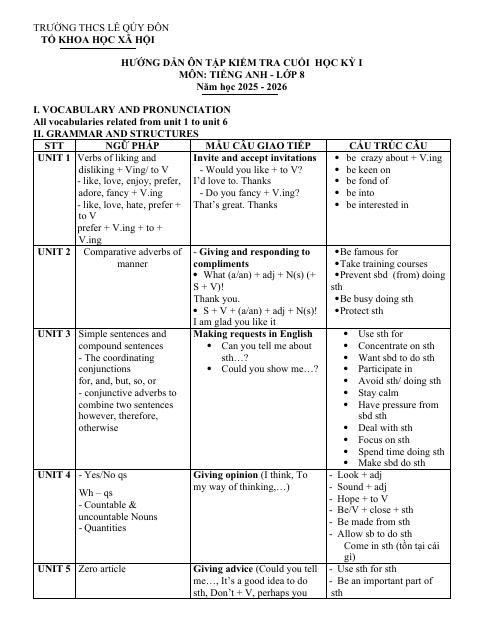
TRƯỜNG THCS LÊ QÚY ĐÔN TỔKHOA HỌC XÃ HỘI
HƯỚNG DẪN ÔN TẬP KIỂM TRA CUỐI HỌC KỲI MÔN: TIẾNG ANH - LỚP 8 Năm học 2025 - 2026
I. VOCABULARY AND PRONUNCIATION All vocabularies related from unit 1 to unit 6 II. GRAMMAR AND STRUCTURES
STT NGỮPHÁP MẪU CÂU GIAO TIẾP CẤU TRÚC CÂU UNIT 1 Verbs of liking and disliking + Ving/ to V - like, love, enjoy, prefer, adore, fancy + V.ing - like, love, hate, prefer + to V prefer + V.ing + to + V.ing
Invite and accept invitations - Would you like + to V? I’d love to. Thanks - Do you fancy + V.ing? That’s great. Thanks
be crazy about + V.ing be keen on be fond of be into be interested in
UNIT 2 Comparative adverbs of manner
- Giving and responding to compliments What (a/an) + adj + N(s) (+ S + V)! Thank you. S + V + (a/an) + adj + N(s)! I am glad you like it
Be famous for Take training courses Prevent sbd (from) doing sth
Be busy doing sth Protect sth
UNIT 3 Simple sentences and compound sentences - The coordinating conjunctions for, and, but, so, or - conjunctive adverbs to combine two sentences however, therefore, otherwise
Making requests in English
Can you tell me about sth…? Could you show me…?
Use sth for Concentrate on sth Want sbd to do sth Participate in Avoid sth/ doing sth Stay calm Have pressure from sbd sth Deal with sth Focus on sth Spend time doing sth Make sbd do sth UNIT 4 - Yes/No qs
Wh – qs - Countable & uncountable Nouns - Quantities
Giving opinion (I think, To my way of thinking,…)
- Look + adj - Sound + adj - Hope + to V - Be/V + close + sth - Be made from sth - Allow sb to do sth Come in sth (tồn tại cái gì) UNIT 5 Zero article Giving advice (Could you tell me…, It’s a good idea to do sth, Don’t + V, perhaps you
- Use sth for sth - Be an important part of sth
should + V) - Pray for sth - One of the/possessive Adj + plural N Have a tradition of V- ing/N UNIT 6 Future simple First conditional (If, Unless)
Expressing certainty (sure, Yes, certainly
- Be famous for, be well- known for, be known for - Be in the habit of doing sth - Be in a hurry (to do sth) - It’s + adj(+for sb)+ to do st - Be harmful to sth Be able to + V
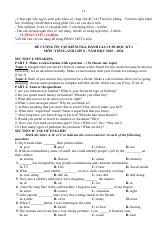
III- SPEAKING: Talk about one of these topics 1.Talking about leisure activities with your family. 2.Talking about the village or town where someone lives. 3. Talking about your school clubs 4. Talking about types of home you live in. 5. Talking about the maintaining traditional lifestyles IV. LISTENING 1. Listen and tick T (true) or F (false). 2. Listen then correct sentences. 3. Listen and choose the best answers: A, B, C or D. 4. Listen and fill the missing words. V. WRITING. (80 - 100 words) 1. Writing a write a paragraph of about 80 word about a minority ethnic group you know. (For example: The Muong in Hòa Bình: + population: about several hundred thousand; /+ living place: Describe where they live; + economy: Mention what they do for a living; /+ food and drink: Typical foods or drinks.(sticky rice, corn, corn wine)/+ traditional culture activities: Festivals, music, dances, or other traditions.) 2. Write about a traditional festival. 3. Writing a paragraph about the advantages or disadvantages of street food VI. PRACTICE: 1. All the exercises from unit 4 to unit 6 in workbook. 2. Some suggested exercises. Ex 1. Choose the correct answer A, B, C, or D with the underlined part pronounced differently in each group. 1. A. singer B. England C. angle D.longevity 2. A. guest B. tiger C. age D. gather 3. A. morning B. thinking C. union D. ornament 4. A. drink B. thank C. funny D. uncle 5. A. keep B. know C. kitchen D. keen 6. A. School B. chemistry C. chaotic D. children *Choose the correct answer A, B, C, or D to complete each sentence. 1. Khmer men teach their children how to ……fish at an early age. A. do B. catch C. raise D. eat 2. The elders often pass on their ….. to the young through stories and activities.
Trên đây là phần đầu tài liệu — bấm Đọc sách để xem đầy đủ.