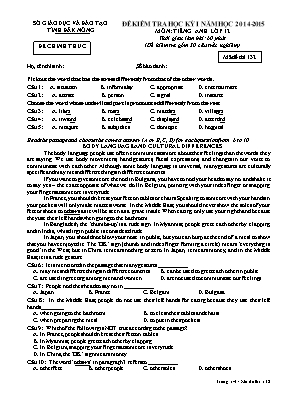
Đề kiểm tra học kỳ I năm học 2014-2015 tỉnh Đăk Nông môn Tiếng Anh lớp 12 - GDPT
Báo tài liệu không phù hợp
Xem trước nội dung
Trang 1/4 - Mã đề thi 132
SỞ GIÁO DỤC VÀ ĐÀO TẠO
TỈNH ĐĂK NÔNG
ĐỀ KIỂM TRA HỌC KỲ I NĂM HỌC 2014-2015
MÔN: TIẾNG ANH LỚP 12
Thời gian làm bài: 60 phút (Đề kiểm tra gồm 50 câu trắc nghiệm)
Mã đề thi 132
Họ, tên thí sinh:..................................................,Số báo danh:......................................
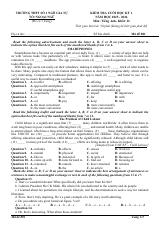
Pick out the word that has the stress differently from that of the other words . Câu 1: A. situation B. informality C. appropriate D. entertainment Câu 2: A. attract B. person C. signal D. instance Choose the word whose underlined part is pronounced differently from the rest. Câu 3: A. likes B. roses C. matches D. villages Câu 4: A. invited B. celebrated C. displayed D. attended Câu 5: A. measure B. subsidies C. domestic D. hospital
Read the passage and choose the correct answer (A or B, C, D) for each question from 6 to 10
BODY LANGUAGE AND CULTURAL DIFFERENCES The body language people use often communicates more about their feelings than the words they are saying. We use body movements, hand gestures, facial expressions, and changes in our voice to communicate with each other. Although some body language is universal, many gestures are culturally specific and may mean different things in different countries.
If you want to give someone the nod in Bulgaria, you have to nod your head to say no and shake it to say yes – the exact opposite of what we do! In Belgium, pointing with your index finger or snapping your fingers at someone is very rude.
In France, you shouldn’t rest your feet on tables or chairs. Speaking to someone with your hands in your pockets will only make matters worse. In the Middle East, you should never show the soles of your feet or shoes to others as it will be seen as a grave insult. When eating, only use your right hand because they use their left hands when going to the bathroom.
In Bangladesh, the ‘thumbs-up’ is a rude sign. In Myanmar, people greet each other by clapping, and in India, whistling in public is considered rude.
In Japan, you should not blow your nose in public, but you can burp at the end of a meal to show that you have enjoyed it. The ‘OK’ sign (thumb and index finger forming a circle) means ‘everything is good’ in the West, but in China it means nothing or zero. In Japan, it means money, and in the Middle East, it is a rude gesture. Câu 6: It is mentioned in the passage that many gestures __________.
A. may mean different things in different countries B. can be used to greet each other in public C. are used in greeting among men and women D. are not used to communicate our feelings Câu 7: People nod their head to say no in __________.
A. Japan B. France C. Belgium D. Bulgaria Câu 8: In the Middle East, people do not use their left hands for eating because they use their left hands________.
A. when going to the bathroom B. to clean their tables and chairs C. when preparing the meal D. to put in their pockets Câu 9: Which of the following is NOT true according to the passage?
A. In France, people shouldn’t rest their feet on tables. B. In Myanmar, people greet each other by clapping C. In Belgium, snapping your fingers at someone is very rude. D. In China, the ‘OK’ sign means money Câu 10: The word “others” in paragraph 3 refers to __________.
A. other feet B. other people C. other soles D. other shoes
ĐỀ CHÍNH THỨC
ThuVienDeThi.com
Trên đây là phần đầu tài liệu — bấm Đọc sách để xem đầy đủ.