Đề kiểm học kì I môn Tiếng Anh Lớp 9 - Năm học 2015-2016 - Trường PTDTBT THCS Mường Thanh (Có đáp án)
Báo tài liệu không phù hợp
Xem trước nội dung
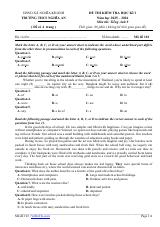
PHÒNG GD&ĐT TÂY TRÀ ĐỀ THI KIỂM TRA HỌC KÌ I TRƯỜNG PTDTBT THCS BẬC THCS NĂM HỌC 2015 – 2016 TRÀ THANH MÔN: TIẾNG ANH – LỚP 9 Thời gian: 60 phút ( không kể thời gian phát đề) (Thí sinh làm bài trực tiếp vào đề thi) ( Đề thi gồm 03 trang)
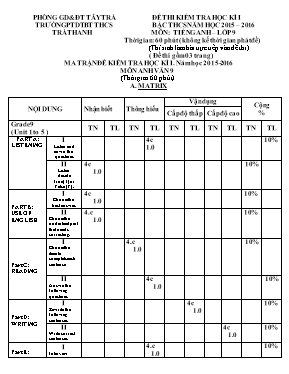
MA TRẬN ĐỀ KIỂM TRA HỌC KÌ I. Năm học 2015-2016
MÔN ANH VĂN 9
(Thời gian 60 phút)
A. MATRIX
Vận dụng NỘI DUNG Nhận biết Thông hiểu Cấp độ thấp Cấp độ cao
Cộng
%
Grade 9 ( Unit 1 to 5 ) TN TL TN TL TN TL TN TL TN TL
I Listen and anwer the questions
4c 1.0
10% PART A: LISTENING
II Listen decide True (T) or False (F).
4c
1.0
10%
I Choose the best answer.
4c
1.0
10%
PART B: USE OF ENGLISH
II Choose the underlined part that needs correcting.
4.c
1.0
10%
I Choose the item to complets each sentence
4.c
1.0
10%
Part C: READING
II Answer the following questions
4c 1.0
10%
I Rewrite the following sentences
4c
1.0
10% Part D: WRITING II Write correct sentences
4c 1.0
10%
Part E: I Interview
4.c 1.0
10%
ThuVienDeThi.com
SPEAKING II Answer topic
1.c 1.0
10%
Tổng số câu 12c 4c 12c 5c 4c 16c 21c
Tổng số điểm 3.0 1.0 3.0 2.0 1.0 4.0 6.0
Tỉ lệ % 30% 20% 20% 20% 10% 40% 60%
ĐỀ KIỂM TRA HỌC KÌ I-NH 2015-2016
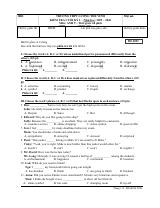
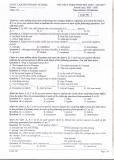
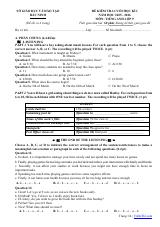
B. QUESTIONAIRE PART A: LISTENING I. Listen and anwer the questions ( short answers). (1pt) 1. Is your village about 55 kilometers from the city center ? ................................................ 2. How is your village? ....................................... 3. When does your village look like a carpet with plenty of colors? ........................................ 4. Can people walk along the path and enjoy the fresh smell of the flowers? ..................................... II. Listen and then decide whether the following statements are True (T) or False (F). (1pt) 5. Radio programming was different from what it is now after the appearance of TV sets………….. 6. Radio stories do not require listeners to use their imagination. ………….. 7. Families used to gather around a radio to hear the news or to listen to a programme. ………….. 8. Most people now listen to radio programmes in their car…………... PART B: USE OF ENGLISH I. Choose (A, B, C or D) to complete each of the following sentences. (1pt) 9. Vietnamese women prefer to wear modern clothing at work, ………………….? A. doesn’t she B. aren’t they C. don’t they D. didn’t she 10. The “Ao dai” is the ……………… dress of Vietnamese women. A. causal B. traditional C. socail D. daily 11. When I was at the primary school, my mother …………… me to school every day. A. used to take B. is used to taking C. takes D. was taking 12. The Internet nowadays has become an important means of ……………….. A. relation B. combination C. connection D. communication II. Choose the underlined part among (A, B, C, D) that needs correcting. (1pt) 13. She wishes she will be a teacher of English some day.
A B C D
ThuVienDeThi.com
14. A new school is going to build in that area. A B C D 15. On summer the weather is often hot. A B C D 16. The mother asked her son what did he want for his birthday.
A B C D PART C: READING I. Choose the item among (A, B, C, D) that best complets each sentence each below about the passage(1pt)
Every year, students in many countries learn English. Some of these students are young children. Others are teenagers. Many are adults. Some learn at school, others study by themselves. A few learn English just by hearing the language in films, on television, in the office or among their friends. But not many lucky enough to do that. Most people must work hard to learn another language.
Many boys and girls learn English at school because it is one of their subjects. They study their own language, mathematics, and English. In England, America or Australia, may boys and girls study their native language which is English, mathematics and another language, perhaps French or German. Many adults learn English because it is useful for their work. Teenagers often learn English for their higher studies, because some of their books are …
Trên đây là phần đầu tài liệu — bấm Đọc sách để xem đầy đủ.