Xem trước nội dung
Thẩm Tâm Vy, July 24th, 2019 GRAMMAR FOR ADVANCED LEARNERS ADVERBS
GRAMMAR FOR ADVANCED LEARNERS
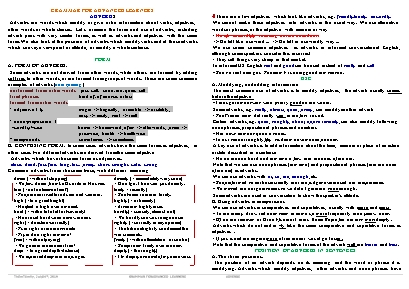
ADVERBS Adverbs are words which modify or give extra information about verbs, adjectives, other words or whole clauses. Let’s examine the form and use of adverbs, including adverb pairs with very similar forms, as well as adverbs and adjectives with the same form. We also look at the position of adverbs which modify verbs and at those adverbs which convey a viewpoint or attitude, or modify a whole sentence.
FORM A. FORM OF ADVERBS. Some adverbs are not derived from other words, while others are formed by adding suffixes to other words, or are formed from groups of words. These are some common examples of adverbs (note spelling): not formed from other words: just, well, soon, too, quite, still fixed phrases kind of, of course, at last formed from other words * adjective + ly: tragic => tragically, excitable => excitably,
easy => easily, real => reall * noun/preposition + -ward(s)/-wise home => homeward, after => afterwards, price =>
pricewise, health => healthwise * compounds some+times => sometimes B. CONFUSING FORM. ln some cases adverbs have the same forms as adjectives; in other cases two different adverbs are derived from the same adjective: Adverbs which have the same form as adjectives: close, deod, fost, fine, long, low, pretty, short, straight, wide, wrong Common adverbs from the same base, with different meaning
direct (= without stopping) - We flew direct from La Guardia to Houston. late (= not on time/not earl') - The plane arrived late due to bad weather. high (= to a great height) - He lifted it high over his head. hard (= with a lot of effort/severelyJ - He braked hard when he saw the cat. right (= direction/correctly) - Turn right at the crossroads. - Try to do it right this time! free (= without paying) - We got into the concert free! deep = to a great depth/distance) - We explored deep into the jungle.
directly (= immediately/very soon) - Don't go. I'll be with you directly. lately = recently) - She's been rather ill lately. highly (= extremely) - Arsenic is highly toxic. hardly (= scarcely, almost not) - We hardly know our neighbours. rightly (= correctly in my opinion) - The tribunal rightly condemned the war criminals. freely (= without limitation or control) - Sheep roam freely over the hills. deeply (= thoroughly) - I'm deeply ashamed of my behaviour.
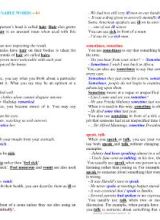
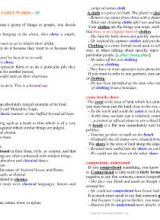
There are a few adjectives which look like adverbs, e.g. friendly,lonely, cowardly. We cannot make these adjectives into adverbs in the usual way. We use alternative words or phrases, or the adjective with manner or way: - He left cowardlyly, sneaking out the back door. => He left like a coward ... => He left in a cowardly way ... We use some common adjectives as adverbs in informal conversational English, although some speakers consider this incorrect: - They sell things very cheap in that market. In informal US English real and good can be used instead of really and well: - She’s a real nice girl. The team's running good this season.
USE A. Modifying, and adding information The most common use of adverbs is to modify adjectives; the adverb usually comes before the adjective: - I thought his answers were pretty good on the whole. Some adverbs, e.g. really, almost, quite, pretty, can modify another adverb: - The French team did really well in the first round. Certain adverbs, e.g. quite, roughly, about, approximately, can also modify following noun phrases, prepositional phrases and numbers: - Her news came as quite a shock. - In our school roughly fifty students have mobile phones. A key use of adverbs is to add information about the time, manner or place of an action or state described in a sentence: - He hit the ball hard and this time it flew into the back of the net. Note that we can use noun phrases (this time) and prepositional phrases (into the bach of the net) as adverbs. We can use adverbs with as, so, too, enough, etc.: - She performed so …
Trên đây là phần đầu tài liệu — bấm Đọc sách để xem đầy đủ.