Xem trước nội dung
Thẩm Tâm Vy’s Archive THE REVERSE DICTIONARY ~ READER’S DIGEST
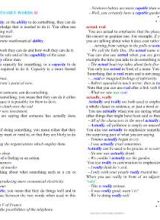
THE REVERSE DICTIONARY AND HOW IT WORKS
Everyone has experienced the frustration of mislaying a familiar word. You know what you want to say; you know that the precise word exists that would enable you to say it; and you know that you know this word ... but when you reach for it, it’s not there. That’s when the pantomime of exasperation begins: you snap your fingers, you frown, you rummage about in your mental attic, you say “It’s on the tip of my tongue” or “What’s that word — oh, you know.” But the word, hovering just out of reach, continues to elude and tantalise you. Psychologists studying this phenomenon compare it to being on the brink of a sneeze. Anticipation ... concentration ... and — frustration. What’s needed, so to speak, is a pinch
of snuff. The Reverse Dictionary provides one. It’s a linguistic snuffbox, helping to release that pent-up sneeze. The relief it affords should be considerable. Several angles of attack The Reverse Dictionary is above all a word-finder. Its purpose is to identify the precise word for an idea that may be in your mind but that you can’t express. You have the idea; the book provides the word. It does this by directing you from a familiar word connected with the idea to the elusive word you are looking for — from the word you know to the word you need. The familiar “cue word” leads to the tricky “target word” in any of three different ways: — by means of a definition leading you directly to the target word — by referring you to a chart of terms on a particular subject, with the target word among them — by referring you to an illustration on which the target word is pinpointed. Suppose you are trying to recall or discover the name for the sculpture of a woman that serves as a column supporting the roof of a building in ancient Greece. Various words come to mind as possible cues — woman, say, or sculpture, or column. Look up any of these cue words, and it will lead you to the target word CARYATID. Woman takes you there by way of a definition, sculpture by way of a chart of sculpture terms, and column by way of an illustration. Note the distinctive feature of this approach in each case: instead of starting with a headword and moving on to the definition, as in a conventional dictionary, the Reverse Dictionary starts with the definition, as it were, and leads from there to the word you are seeking — hence the title of the book. Hitting the target Most target words can be approached from several directions. First, you can look up any of several synonyms. If you’re trying to remember the word TRAJECTORY, for instance, you’ll find it if you look up pathorcurve (“curved flight path...”) or flight (“flight path...”). Or you may approach the target word from its cluster of associations rather than its synonyms: a ball thrown through the air has a trajectory, so you might aim at the target word by looking up ball or throw. And since missiles too have trajectories, you could use the cue word m is s ile to hit the target. The linguistic side of the human mind works by lateral thinking as well as straight-line logical thinking, and many cue words have been selected to make provision for this. You can often approach a target word through its collocations — that is, through phrases in which it commonly occurs, phrases such as connubial bliss, a sedentary job, and rancid butter. You might accordingly look up the cue words bliss , job , and butter to find the respective target words connubial, SEDENTARY, and RANCID. A target word may even be cued by its opposite if that seems a promising approach. So the term relegation could be found by looking up promotion , and LEVITY could be found by looking up serious.
DeThi.edu.vn
Trên đây là phần đầu tài liệu — bấm Đọc sách để xem đầy đủ.